projects
1 | The De-jargonizer
About
What is the De-Jargonizer?
The De-Jargonizer is an automated jargon identification program aimed at helping scientists and science communication trainers improve and adapt vocabulary use for a variety of audiences. The program determines the level of vocabulary and terms in a text, and divides the words into three levels: high frequency/common words; mid-frequency/normal words; and jargon – rare and technical words.
Why do we need a De-Jargonizer?
Scientists are required to communicate science and research not only to other specialists in the field, but also to scientists and specialists from other fields, as well as to the public and policymakers. One fundamental suggestion when communicating with non-specialists is to avoid professional jargon that is excluding and prevents reader-listener comprehension. However, because scientists are trained to speak with highly specialized language, avoiding jargon is difficult for scientists. Also, there is no standard to aid scientists in adjusting their messages. The De-Jargonizer highlights problematic jargon, allowing those communicating science to consider changing these potentially problematic words with more familiar words (or adding explanations).
Who can benefit from using the De-Jargonizer?
Scientists, science communicators, and science communication trainers can all benefit from the de-jargonizer. Scientists and science communicators can use it to adapt their message for non-specialists. Science communication trainers can use it to assess the progress of their students by evaluating their use of appropriate vocabulary.
New Interactive Science Communication Tasks
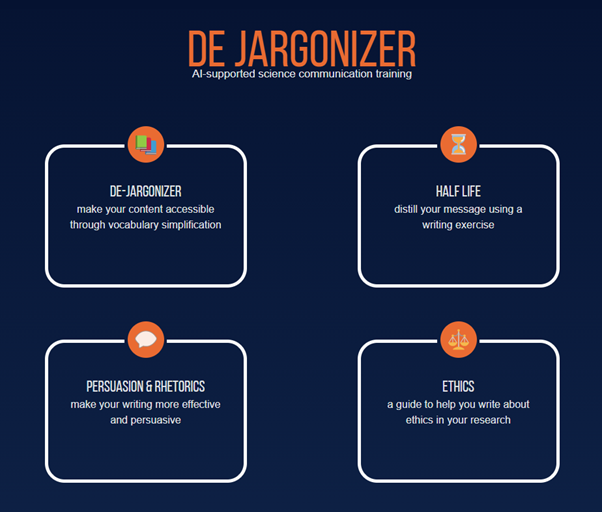
The De-jargonizer site has recently introduced innovative AI-based tools and tasks that make the writing process more accessible and effective, focusing on jargon/vocabulary, writing concisely, persuasive writing, and writing about ethical aspects of research.
Each task provides hands-on strategies to refine your writing for various audiences. Ideal for scientists, engineers, and academics seeking to communicate with clarity and impact.
The half-life task: Guides users in creating a series of short research summaries for various audiences, refining each version with individualized AI feedback. Research shows that this iterative feedback process helps researchers improve jargon use and readability.
The persuasive writing task: Master Aristotle’s rhetorical triangle (Logos, Pathos, Ethos) to learn and practice using guidelines for compelling scientific narratives. Learn to balance logical arguments, emotional appeals, and credibility to connect with diverse audiences effectively.
The ethics in research task: This activity guides researchers to think about the ethical issues they may have to deal with in their research, and how they can be communicated effectivelyץ
2 | The writing center
Even after students take a writing course, and even after having some writing experience, very often the challenges of writing research articles continue. Therefore, in universities around the world, even in English-speaking countries, writing centers exist to give students 1:1 help.
These 1:1 meetings are not editing services, but rather a meeting on a work in progress that needs direction and improvement.
Therefore, we have opened a writing center for students at the Department of Humanities and Arts, Technion aims to assist students 1:1 in improving their academic writing for publication and international conferences. Dr Tzipora Rakedzon oversees the academic organization of the program, along with her co-director, Dr Orit Rabkin, and Ms. Shlomit Ben-Ish is in charge of the administrative side.
The writing center has been advertised to all faculty and graduate students by email through the Technion Graduate School. In addition, we have opened a page on our new department website.
Our main aim is to meet with students and give them instruction and feedback on their papers, theses, dissertations, oral presentations, or professional writing needs (e.g., proposals, postdoc/grant applications, CVs, and cover letters). We offer special assistance to reservists who need help with any of their academic needs related to English courses or activities. In addition, we provide assistance to undergraduate students in faculty content courses that are in English, and to faculty that need to teach and/or publish in English.
3 | IMPACT (Inter-Mediterranean Peace And Collaboration)
I am part an Associate Partner of IMPACT (Inter-Mediterranean Peace And Collaboration), a consortium of HEIs, organizations, youth associations, and technology companies from Europe, Israel, and Morocco. Through its actions, the project aims to foster intercultural dialogue and soft skills development.
As part of our collaboration for the 2024-5 academic year, I am giving lectures on academic writing and multicultural communication in online courses for an international group of students